
Agentic Commerce Part #1: What Platform Product Managers Need to Know
Understanding the protocol shift that's reshaping e-commerce

The Shopping Revolution Nobody Saw Coming
A few months ago, if you told ChatGPT you needed gear for a 3-day winter camping trip, you’d get a helpful breakdown of what to buy. Then you’d open twelve browser tabs, compare products across REI, Backcountry, and Amazon, read reviews, check compatibility, and calculate if you’re under budget.
Now you can say, “Outfit me for a 3-day winter camping trip under $800,” and an AI agent appears directly inside your conversation. It finds a tent, sleeping bag rated for the forecasted temperatures, a compatible pad, camp stove with fuel, and meals all cross-referenced for compatibility, purchased from three different merchants, and scheduled to arrive two days before your trip.
This isn’t science fiction. This is agentic commerce, and it’s already shipping.
What is ChatGPT apps and how to build one ?

OpenAI launched their Agentic Commerce Protocol (ACP) in October 2024. Stripe followed with their Agentic Commerce Suite. Google rolled out Universal Commerce Protocol on Search. Shopify announced their Agentic Plan.
The pattern is clear: agentic commerce represents a rare distribution opportunity, the kind that comes around once or twice a decade.
The last comparable moments were the App Store in 2008, the rise of SEO in the early 2000s, and maybe Shopify’s app ecosystem in 2012.
If you’re a platform product manager, founder, or executive in commerce, this two-part series will answer:
Part 1:
What is agentic commerce actually? (Beyond the hype)
How does it work? (Protocol architecture)
What changed? (Three broken assumptions)
Where should you start? (Readiness audit)
Let’s start by understanding this through the lens of protocols, the same way you’d understand the web by learning HTTP.
1. Understanding Agentic Commerce Through Protocols
The Communication Layer Analogy
Before we dive into agentic commerce, let me share a mental model that makes everything click.
Think about how different systems communicate:
Embeddings → ML Models Text and images get converted into numerical vectors (arrays of numbers). ML models operate on these numerical representations. This allows models to do math on meaning.
Web/Internet → HTTP Protocol Browsers and servers talk via HTTP/HTTPS. It’s a standardized request-response format that enables any browser to work with any server.
LLMs → MCP Protocol MCP (Model Context Protocol) is the emerging standard for AI. It allows LLMs to securely connect to data sources and tools. Think of it as HTTP for the AI age.
Human → Human → Natural Language We use spoken/written language. It’s rich with context, nuance, and ambiguity. Most flexible, most complex.
Each layer needs a shared protocol to enable communication. This is the fundamental insight that makes agentic commerce work.
The Agentic Commerce Stack
Here’s how the layers work together:
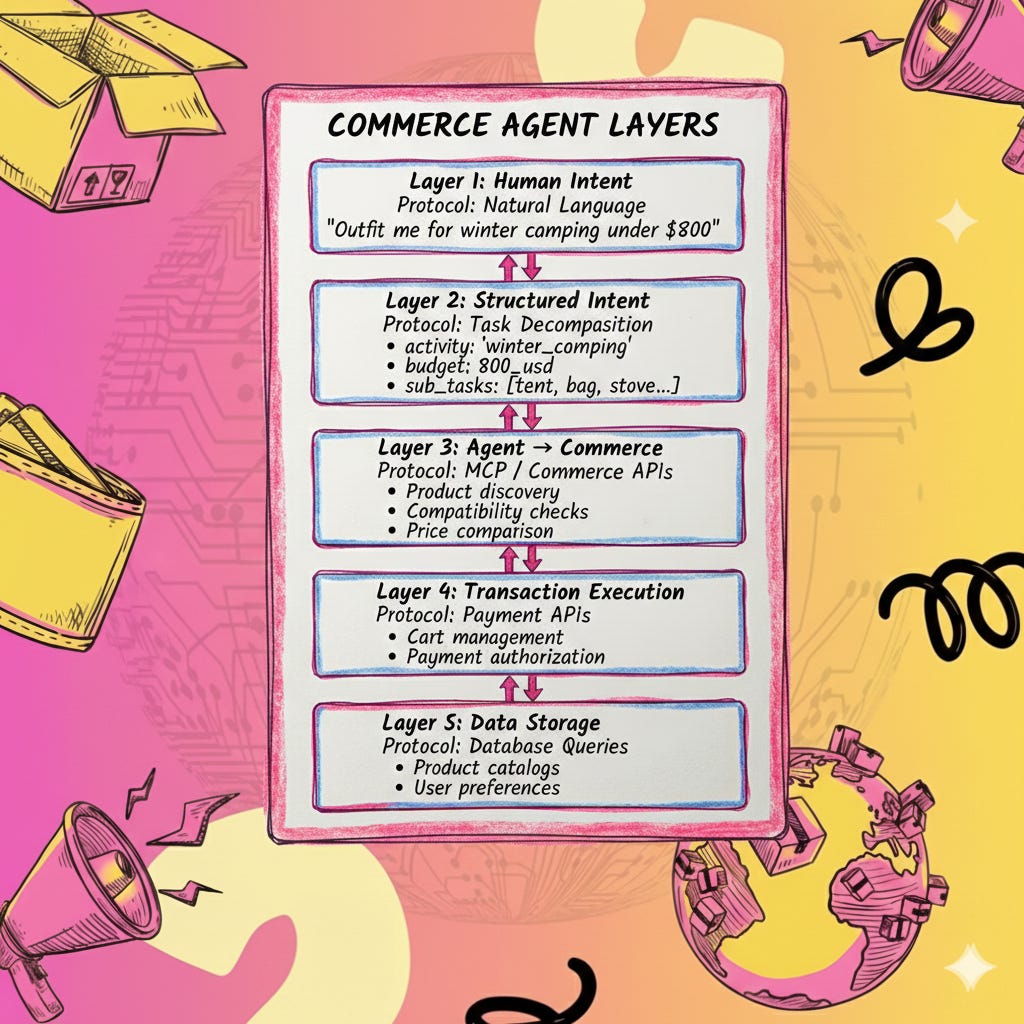
Why This Matters:
Traditional E-commerce: Human → Browser (HTTP) → Web Server → Database
Each hop is optimized for human eyes (beautiful UI, intuitive navigation).
Agentic Commerce: Human → LLM (Natural Language) → MCP → Commerce APIs → Database
Middle layers are optimized for machine consumption (structured data, reliable APIs).
The fundamental shift: Your storefront is now your API documentation.
2. What Actually Changed?
From Passive Recommendations to Autonomous Shopping
For the past decade, commerce AI meant recommendations. “Customers who bought this also bought that.” Helpful, but passive. Many Industry engineering orgs were built on this model search and recommendation, content understanding.
Agentic commerce is different. AI agents don’t just suggest, they:
Plan complex multi-product purchases
Compare across merchants and categories
Decide based on your constraints
Transact autonomously within guardrails
Follow up on delivery and issues
The user experience transforms from “click through endless product pages” to “state your goal and let the agent handle it with timely nudges.”
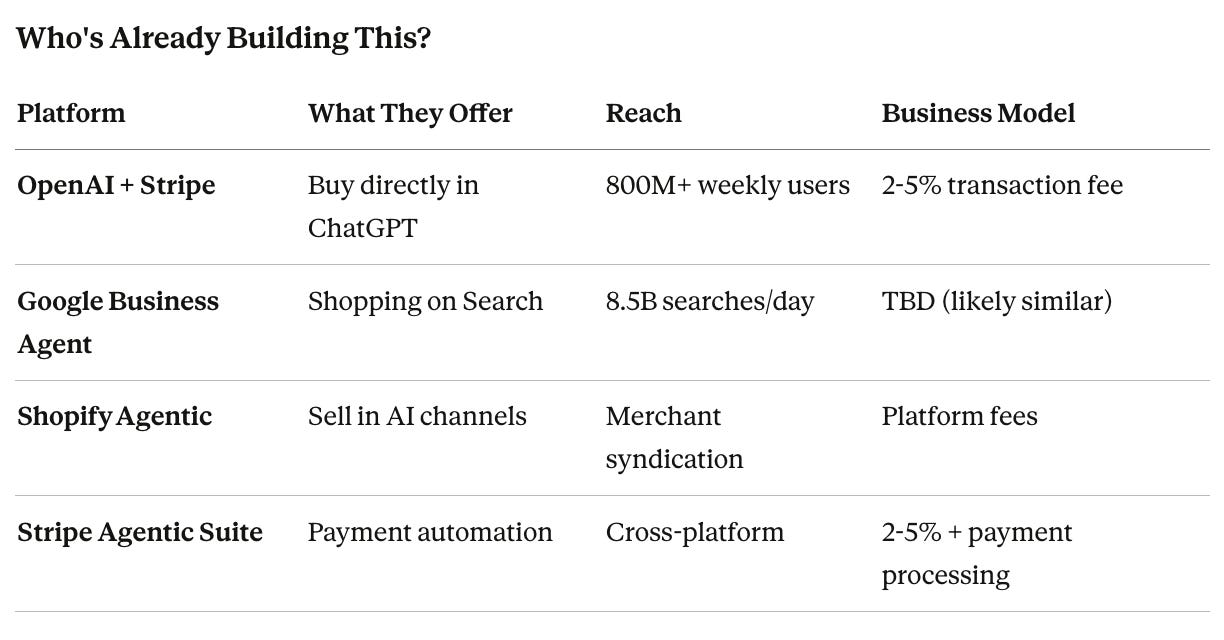
App Store Land Grab - 20 Assets to secure digital real estate in the Agentic Economy
The pattern: Horizontal AI platforms (ChatGPT, Google) sit in front of customers. Commerce infrastructure (Stripe, Shopify) and merchants plug in behind through standardized protocols.
3. Three Broken Assumptions
Do you know that Agentic commerce breaks three core assumptions that have governed online shopping for 25 years ?
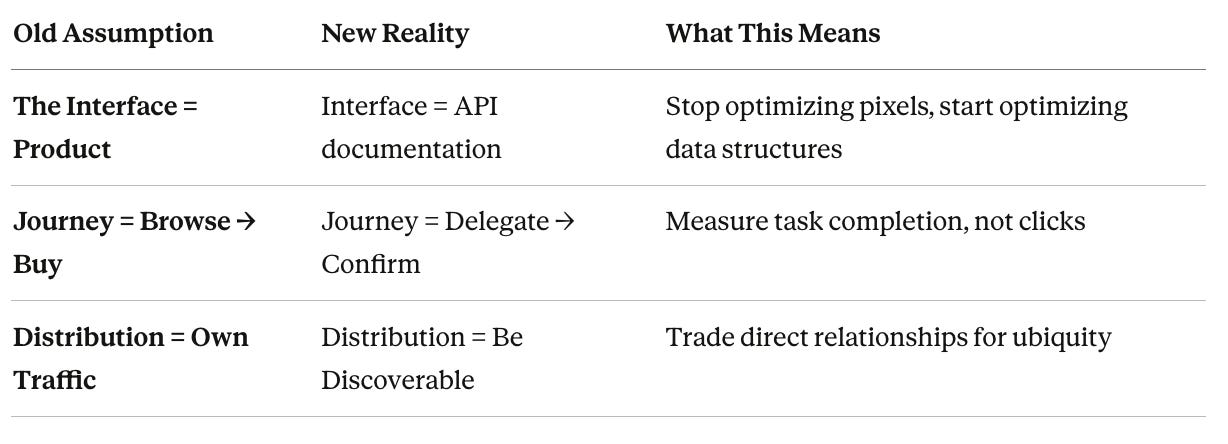
What Changed
1. Interface Shift
Old: A/B test button colors, page load times
New: Agents read APIs, structured catalogs, machine-readable policies
Action: Make your business machine-readable
2. Journey Shift
Old: Users browse, compare, add to cart (measure: session duration, bounce rate)
New: Users delegate tasks (measure: did agent complete goal correctly?)
Example: “Get everything for home office <$2k” vs. 12 browser tabs
3. Distribution Shift
Old: SEO, ads, brand loyalty (own the customer relationship)
New: Customer → ChatGPT → Your API → Stripe → You fulfill
Trade-off: Never see the customer, but ubiquitously purchasable
4. The Ladder of Autonomy
Not every purchase should be autonomous. Here’s a framework with three levels:
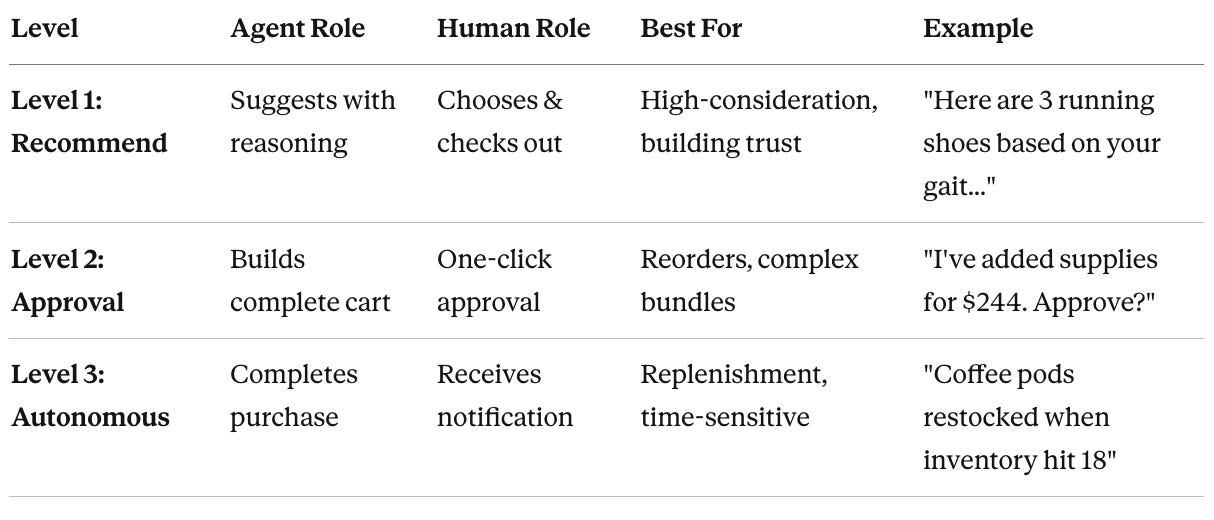
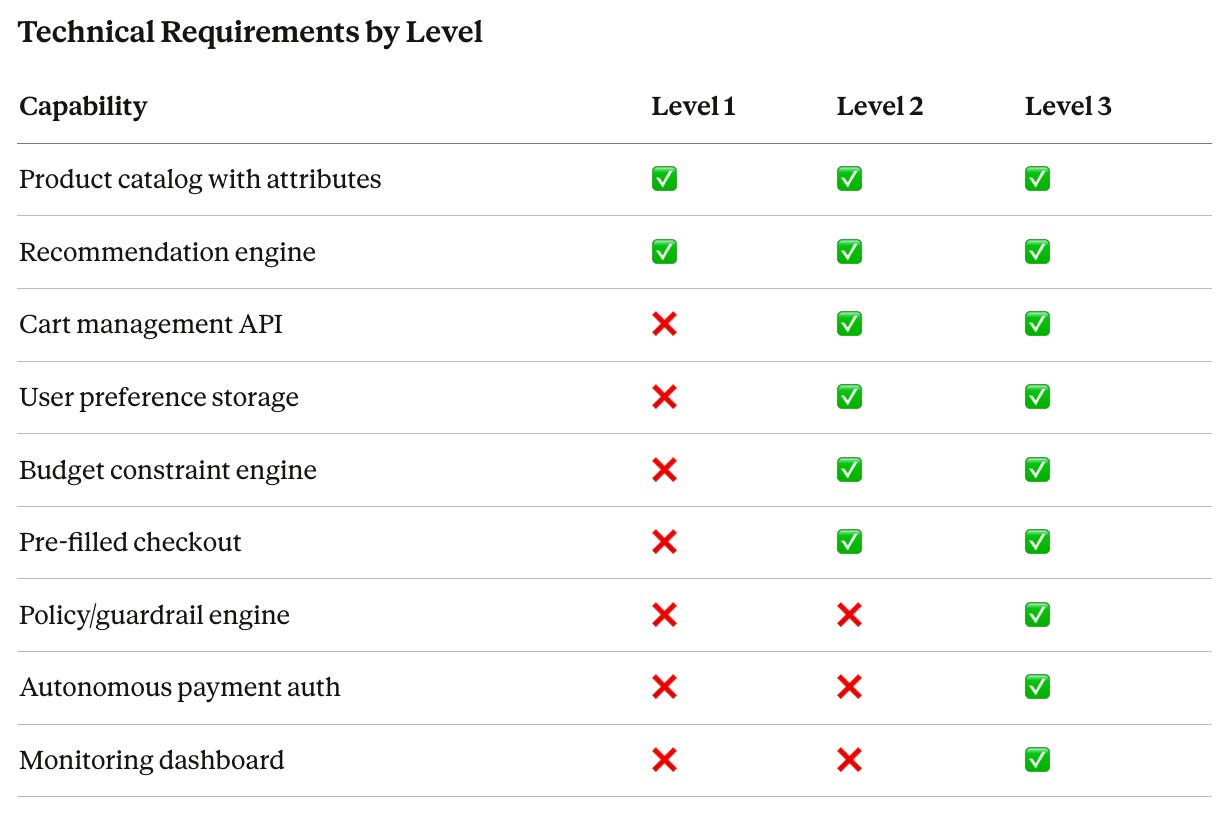
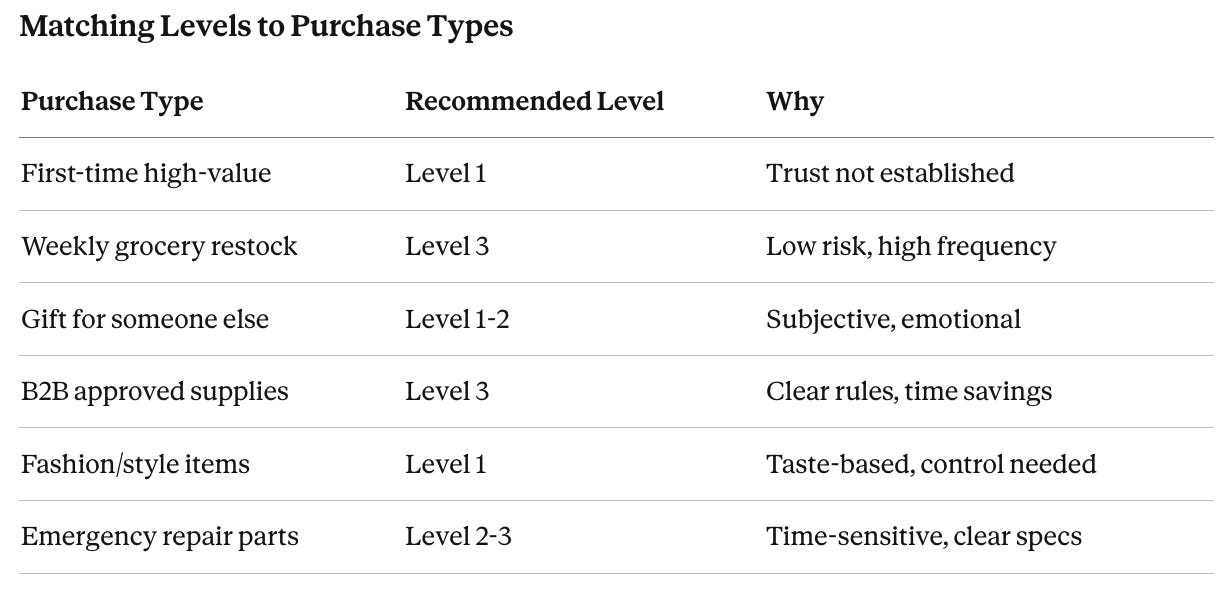
The PM’s job isn’t climbing to Level 3 for everything, it’s matching the right level to each purchase type.
5. Where Do You Start as a Platform PM?
Step 1: Run the Agent Readiness Audit
Score yourself (0-100%) on each dimension:
Product Catalog Quality
□ Structured attributes (not just descriptions)
□ Complete specifications (machine-readable)
□ Relationship mapping (compatible-with, replaces)
□ Real-time inventory accuracy
Policy Clarity
□ Return policies as structured data
□ Shipping rules (zones, times, costs)
□ Warranty terms (parseable)
□ Pricing rules (discounts, promos)
API Infrastructure
□ Product discovery endpoints
□ Cart management APIs
□ Checkout/payment APIs
□ 99.9%+ uptime
User Preferences
□ Budget constraint storage
□ Category preferences
□ Approval workflows
Your Readiness Level:
0-50%: Not ready. Fix data first. (Estimated: 3-6 months)
50-75%: Start Level 1 (Recommend). (Ready in: 1-2 months)
75-100%: Explore Level 2-3. (Ready now)
Step 2: Identify High-Value Use Cases
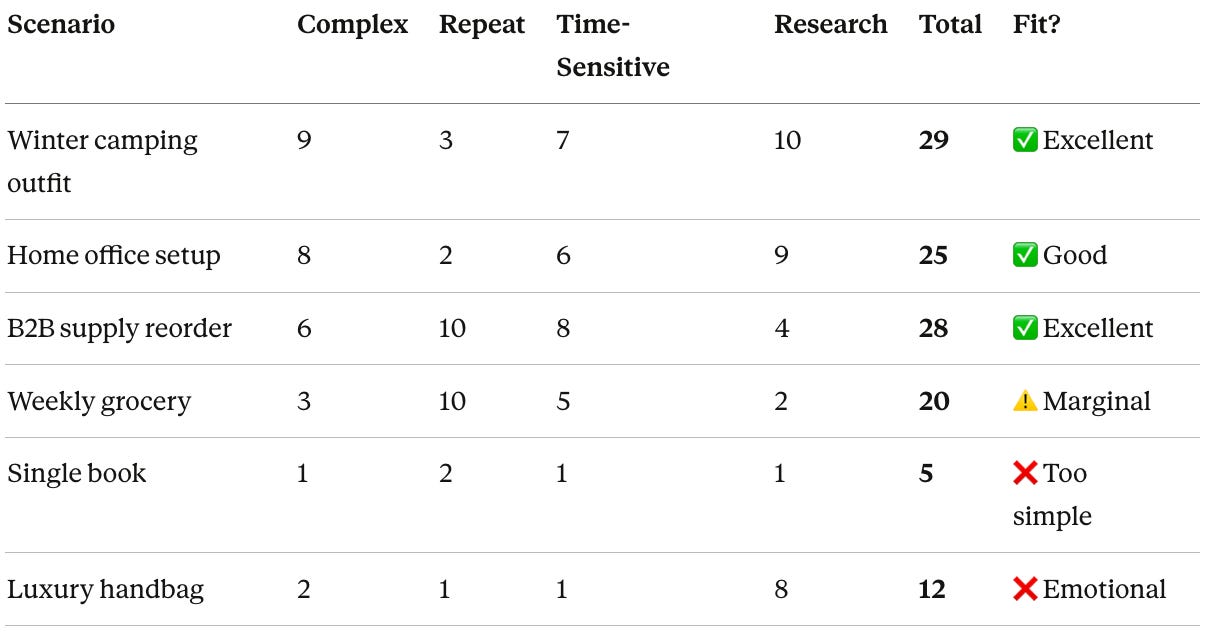
Score each purchase scenario (1-10):
Complexity (how many products/decisions?)
Repetition (how often?)
Time-sensitivity (is speed valuable?)
Research burden (comparison needed?)
Rule: Prioritize scenarios with scores > 25
Step 3: Map Your Data Readiness
For your top 3 use cases, audit:
Product catalog completeness
Policy machine-readability
API reliability
If any dimension < 60%, that’s your bottleneck. Fix it before building agent features.
6. Trust Is The Foundation
The biggest barrier to agentic commerce isn’t technology, it’s trust. Will customers let AI spend their money?
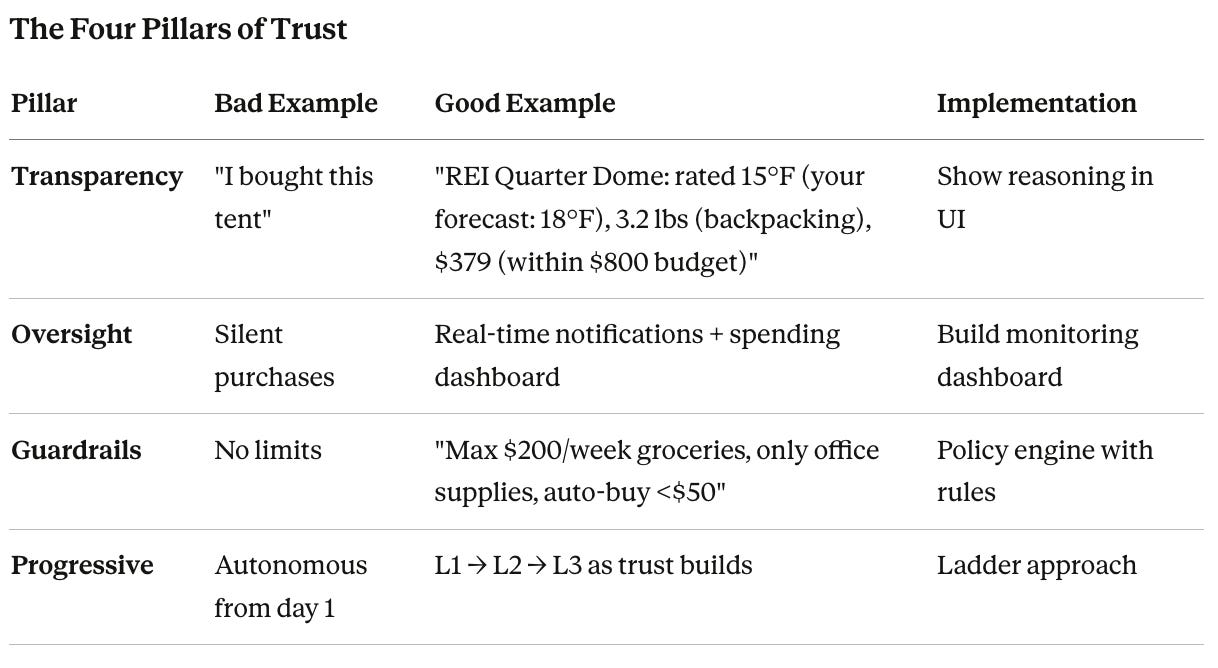
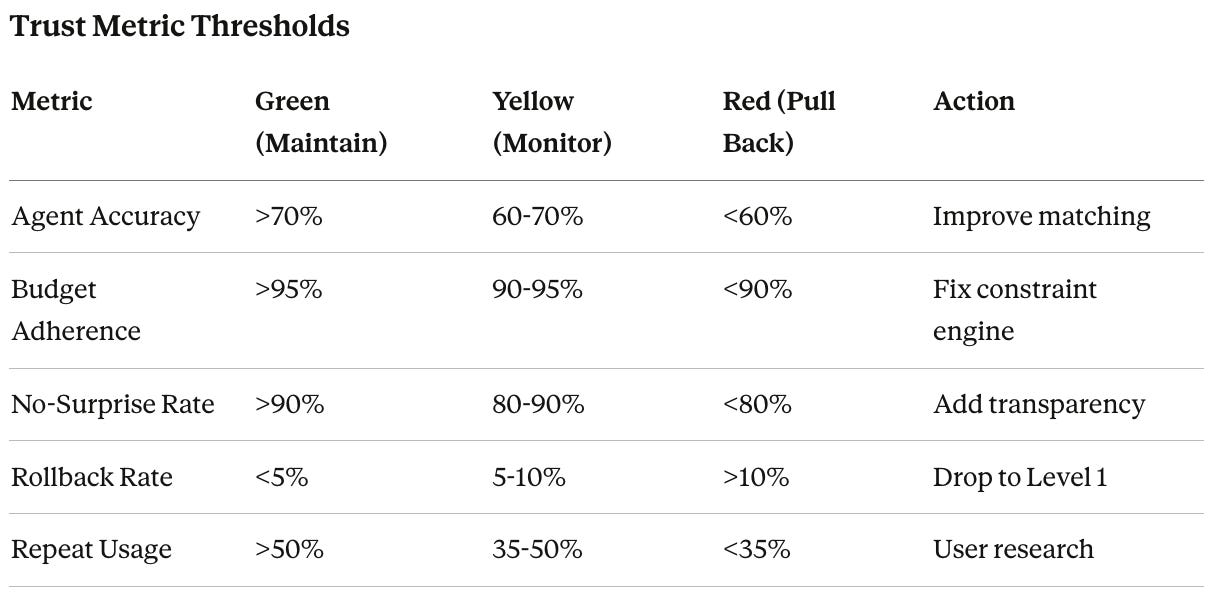
Rule: If ANY metric hits Red → Immediately reduce autonomy level
Don’t build anything until you know all the above number.
Want to go deeper on agentic commerce? Reply with your readiness score and biggest question - I’ll address the most common ones in Part 2.
See you next week with the investment playbook.
This is a great way to make the shift feel concrete instead of abstract. The comparison between tab hopping and a single intent driven request really shows how behavior changes when execution collapses into one step. Framing this as a protocol moment, not just a feature upgrade, feels right. It’s less about convenience and more about who controls decision flow now. That’s the part people underestimate.
This resonates a lot. The protocol shift is real - but I’ve noticed a gap between “agentic as architecture” and “agentic in production reality.”
In retail orgs, the distinction between true autonomous decision-making and workflow orchestration matters a lot for risk, governance, and trust.
I wrote recently about how ecommerce teams can differentiate those layers - less from the platform side, more from the implementation side.
Feels like both views together help ground the hype.